Deciding When You Are Stuck
You have weighed it twice and the two options still come out even. Can a coin or a wheel break the tie, and should you listen when it does?
Why Ask a Coin
When two options are close, the hours spent choosing between them can cost more than the gap between the options. What you need is for the question to end. A coin ends it in a second. The harder question is whether to follow what it says, and one economist ran an unusually large experiment to find out.
What Levitt Tested
In 2013, Steven Levitt of the University of Chicago opened a website for people stuck on a real decision. A visitor chose a question such as "Should I quit my job?" or wrote their own. One answer went to heads and the other to tails, a simulated coin was flipped, and the site asked them to follow it for at least two months. Levitt then surveyed them at two and at six months, including a happiness rating from 1 to 10.
About 22,500 usable flips came in, and people did follow the coin. More than half acted as the coin said, and half is what you would expect if the coin did nothing. On the big questions, like quitting a job or ending a relationship, about 56 percent of those who answered at two months followed it. Across all the questions, heads made a change about 25 percentage points more likely than tails.
The happiness result came from the big questions. At two months, there was no clear difference in happiness between people told to change and people told to stay. At six months, those whose coin said change were happier. Levitt took that to mean "people may be excessively cautious when facing life-changing choices."
How Far to Trust It
Levitt is open about the weak spots. His volunteers came mostly through Freakonomics fans online, tended to be young, male, and highly educated, and were recruited because they were stuck, so they were likelier than most people to let a coin sway them. Happiness was self-reported, and only some people answered the follow-ups, with 8,159 six-month surveys from those 22,500 flips. He calls the results "merely suggestive."
There is a second limit in the design. Everyone flipped, so the study compares heads with tails. It does not compare a coin with careful thought. People on the edge who changed did well on average, and that does not make the coin a good judge. The figures here are from the 2016 working paper. The Review of Economic Studies printed it in 2021, so check that version before quoting a number.
Flip, Then Notice How You Feel
A common idea says the flip matters less than your reaction to it. Heads comes up and you feel relief, or tails comes up and your stomach drops, and now you know what you wanted. Mariela Jaffé and Rainer Greifeneder tested a version of this in three studies, in the lab and online. People's feelings about a flip's result did match the preferences they had given beforehand.
They did not find reliable support for the other half, that flipping leads to choices closer to those preferences than a control group makes. So the reaction is real information about your lean, and nothing in that paper shows the flip improves the final choice.
What to Leave to Chance
A random pick suits options that are close, choices where either answer is fine, and cases where being stuck is the real cost. Which restaurant, which of two similar gifts, and which task goes first all qualify, and so does anything you can undo. It suits a decision badly when one option hides a cost you have not looked at, when other people live with the result and did not agree to a coin, or when there is no undoing it. Levitt's site made the same cut in its own way. A visitor who said they were nearly sure of the answer got a note that they seemed to have made up their mind, and could leave without flipping.
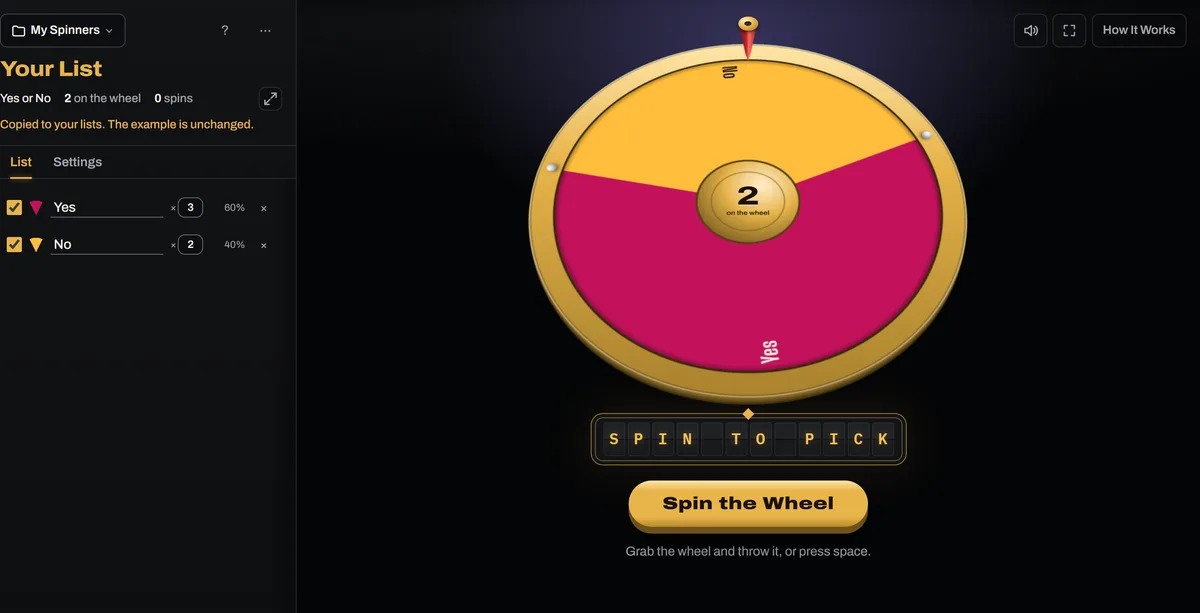
On SpinFlipRoll, the Yes or No wheel gives each answer half. If you lean, a weight records it honestly. Yes at 3 and No at 2 gives Yes 60 percent, and No can still win. The Yes, No, or Maybe wheel adds a third answer, and a Maybe is useful when the real gap is information you have not gathered yet. It tells you to go and get it.
 Open the picture full size, opens in a new tab
Try It
Pick a decision you have been circling that you could undo. Spin the Yes or No wheel and check what you feel before you think about what the answer means. Then try a weight that matches your lean.
Read Next
Is a Coin Flip Really 50/50?Is a coin toss truly fair, and can a coin land on its edge?3 min read How to Make a Fair Random PickWhy not just pick a name yourself, or count round with a rhyme, and what makes a random pick fair?4 min read
Sources
This guide draws on these. Last checked October 15, 2026.
- Heads or Tails: The Impact of a Coin Toss on Major Life Decisions and Subsequent Happiness, Steven D. Levitt, NBER Working Paper 22487, 2016 (opens in a new tab)
- Heads or Tails: The Impact of a Coin Toss on Major Life Decisions and Subsequent Happiness, Steven D. Levitt, The Review of Economic Studies, 2021 (opens in a new tab)
- This outcome feels right! Subjective evaluations of coin flip outcomes reflect previously stated preferences, Mariela E. Jaffé and Rainer Greifeneder, PLOS ONE, 2021 (opens in a new tab)