How to Make a Fair Random Pick
Why not just pick a name yourself, or count round the group with a rhyme, and what would make the pick fair?
Your Head Is a Poor Coin
Ask somebody to make up a long run of coin flips and they will write one that looks right. Heads, tails, tails, heads, tails, heads. It switches sides often and hardly ever repeats three times running. Real flips repeat more than that.
Ruma Falk and Clifford Konold, reviewing the research in 1997, found that people trying to be random "usually produce more alternations than expected by chance." They also rate sequences that switch too much as the most random ones. W. A. Wagenaar, who studied this in the early 1970s, summed up the experiments as showing that "man is a bad randomizer." Falk and Konold add that why it happens, a warped idea of chance or just the quirks of the task, has been seriously contested. Switching too often is the finding that turns up most.
A pick made in your head is steered, and you cannot feel it happening. You skip the name you used last time and favor the one that feels due.
A Counting Rhyme Is Settled Before It Starts
In a rhyme like Eeny, meeny, miny, moe, the child pointed at on the last syllable is the one chosen. The common modern version runs 28 syllables by our count, so the answer is plain arithmetic. Around a ring of 4 children, the 28th point lands on the fourth child counted. In a ring of 5, it lands on the third.
Whoever chants also chooses where to start. To land on Dana, start 27 places before her and count round. Anyone who knows the count can work this out, and nobody else in the circle can check whether the start was an accident. The rhyme feels like chance and gives the person holding it a steering wheel.
What Fair Actually Means
We use two tests. Every entry gets the chance it was said to have, and nobody can steer the result, including the person running it.
Fair does not mean evenly spread. Spin a five name wheel five times and about 96 times in 100 some name comes up twice, because only 120 of the 3,125 possible runs have five different names. A streak is what chance looks like, and a head or a rhyme tends to iron it out. When you need nobody to repeat, that is a separate job with its own setting.
Weights and After a Win Change the Odds on Purpose
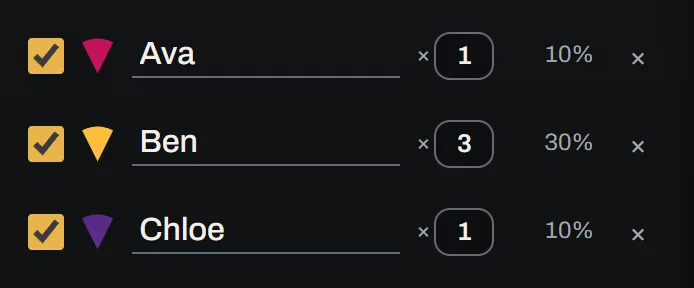
A weight is unfairness that everybody can see. Give Ben a weight of 3 beside two entries at 1 and the wheel gives them 60, 20, and 20 percent. The percentage sits next to each name in the list, so nobody has to guess who is favored. The problem is hidden steering, and a stated lean can be checked.
 Open the picture full size, opens in a new tab
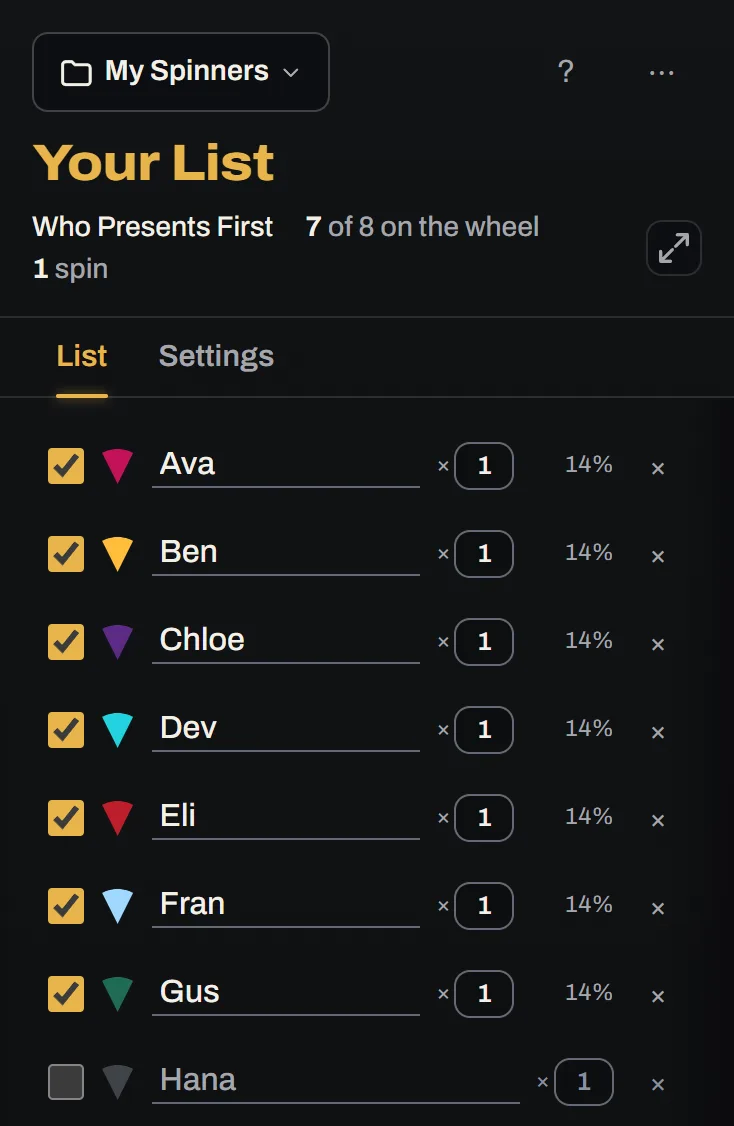
After a Win set to Retires is for picking without repeats. Each winner leaves the wheel but stays on the list, unticked, so you can see who has had a turn. With five equal entries each starts at 20 percent, and after one wins the other four sit at 25 percent. Every spin is still fair to the names left. Put Them All Back On starts a new round. Rests sits between the two. A winner keeps a fifth of its wedge and grows back over the next round, so it can win again, just rarely straight away, and its smaller percentage shows beside its name like any other.
 Open the picture full size, opens in a new tab
Why We Call This Wheel Fair
When you press Spin, the site picks a spot on the rim with your browser's cryptographic random number generator. The wedge under that spot wins, and a bigger wedge covers more rim, so its share of the wheel is its chance. The pick is made at that moment. The wheel is then thrown with real physics, and the throw is worked out to coast to the spot, so the spin you watch is the real path to the answer.
A test in the code checks this. For each of the six styles, it builds wheels of two, five, and forty entries, plus weighted and uneven ones. It spins each one 1,000 times from a seeded generator, which plays the same 1,000 spins on every run. Every throw has to stop on the wedge the draw chose, and the count for each entry has to match its share, judged by a chi-squared check set so that luck alone would fail it about once in a thousand runs. Other tests check that physics can reach every wedge, thin ones included, since a wedge it cannot reach could never win.
The limit is that a wheel you grab and throw yourself goes wherever your throw sends it. The tests above cover the Spin button, which is the one that makes a pick for you.
Try It
Put the names for your next pick on the wheel and press Spin. Try a weight on one of them, then set After a Win to Retires and spin until everybody has had a turn. The help page shows where each setting lives.
Read Next
Picking Teams FairlyHow do you split a group into teams fairly, without anybody being the last one picked?4 min read Running a Raffle or a Prize DrawHow do you run a raffle or a prize draw that everyone trusts?4 min read Choosing Who Speaks Next in a MeetingHow do you pick who speaks next in a meeting so it's fair and nobody waits to be called on?6 min read
Sources
This guide draws on these. Last checked October 15, 2026.
- Making Sense of Randomness: Implicit Encoding as a Basis for Judgment, Ruma Falk and Clifford Konold, Psychological Review, 1997 (opens in a new tab)
- Sequential Response Bias: A Study on Choice and Chance, W. A. Wagenaar, 1972 (opens in a new tab)
- Eeny, meeny, miny, moe, Wikipedia (opens in a new tab)