Picking Teams Fairly
Two captains take turns choosing, and somebody always ends up standing alone at the end. There are fairer ways to split a group.
Why Captains Make It Worse
Two captains stand at the front and take turns calling names. Everyone else waits to learn where they rank, and nobody has to say it out loud because the order says it for them.
Physical education researchers have objected to this for years. A 2013 paper by Bradley Cardinal and colleagues notes that NASPE, the National Association for Sport and Physical Education, long ago called "captains picking teams" an inappropriate practice. The same paper surveyed 293 students about their memories. Those who recalled being picked last reported a significant drop in physical activity later in life.
The evidence is thinner than that sounds. The Cardinal survey asks people to remember their childhoods, so it shows a link and cannot show that being picked last caused anything. A 2016 study by David Barney and colleagues put 233 junior high boys on publicly picked teams or on teams from a confidential draft. The surveys found no significant difference in motivation. Interviews still turned up students who felt for the classmates most likely to go late, and the authors recommended against public picking anyway. An earlier survey by Barney and Brad Strand found high school students rating picking teams in class as appropriate.
Every study above is about school PE. The case against public picking is reasonable and still short of proven. Avoiding it costs nothing, though, so there is little reason to take the risk.
Let Chance Split Them
A random split takes the ranking out of it. Every person has the same chance at every spot, so where somebody lands says nothing about them. It is the fastest fair method and the right one when the group is casual or the skills are close.
Its weakness is luck. Chance can put the three strongest players on one side, and a lopsided game is no fun for either team. When that matters, reach for one of the next two methods.
The Snake Draft
If you do pick in turns, reverse the order every round. With two teams that runs A, B, B, A, A, B, B, A. Whoever picks first in one round waits longest in the next, and the team that just sat through a gap gets two picks together.
Plain alternating, A, B, A, B, gives team A the better player in every pair. Rank eight players from 1 to 8 and alternating hands one team ranks adding to 16 and the other 20. The snake gives each team 18.
The snake is not perfect. A fantasy football commissioner's guide says a later first-round slot is made up for by an earlier second-round one, but "the compensation is often partial" because the top picks are worth more. Players differ far more in fantasy football than they do at a picnic, so the gap is smaller for a pickup game. Even so, the snake narrows an advantage and does not erase it.
When Skill Needs Balancing
For a game where one stacked team ruins the afternoon, sort the players roughly from strongest to weakest first. One organizer can do it, and the list stays private. Then deal the players out in snake order, or take them in pairs from the top and send one of each pair to each team.
Rating people is a judgment call and you will sometimes be wrong. A rough sort into strong, middle, and newer players is enough. Let the draw decide who goes where inside each group.
A Random Split in One Press
The SpinFlipRoll Team Generator makes a random split for you. Paste the names in, one per line, choose how many teams you want or how many people go on each, and press Make Teams. It shuffles the names and deals them round the teams in turn, so no team ends up more than one person bigger than another.
To balance by skill, run it once for each rough group of players, strongest first, with the same number of teams every time, then put Team 1 with Team 1, Team 2 with Team 2, and so on. Each group is spread evenly, so every team gets its share of the strong players. When a group does not divide evenly the first teams take the extra players, so swap one across at the end if the sides come out uneven.
A Snake Draft on the Wheel
For a snake draft, use the spinner. It hands you names one at a time in random order, and you say which team each one goes to.
- Paste everybody's names into the spinner's list.
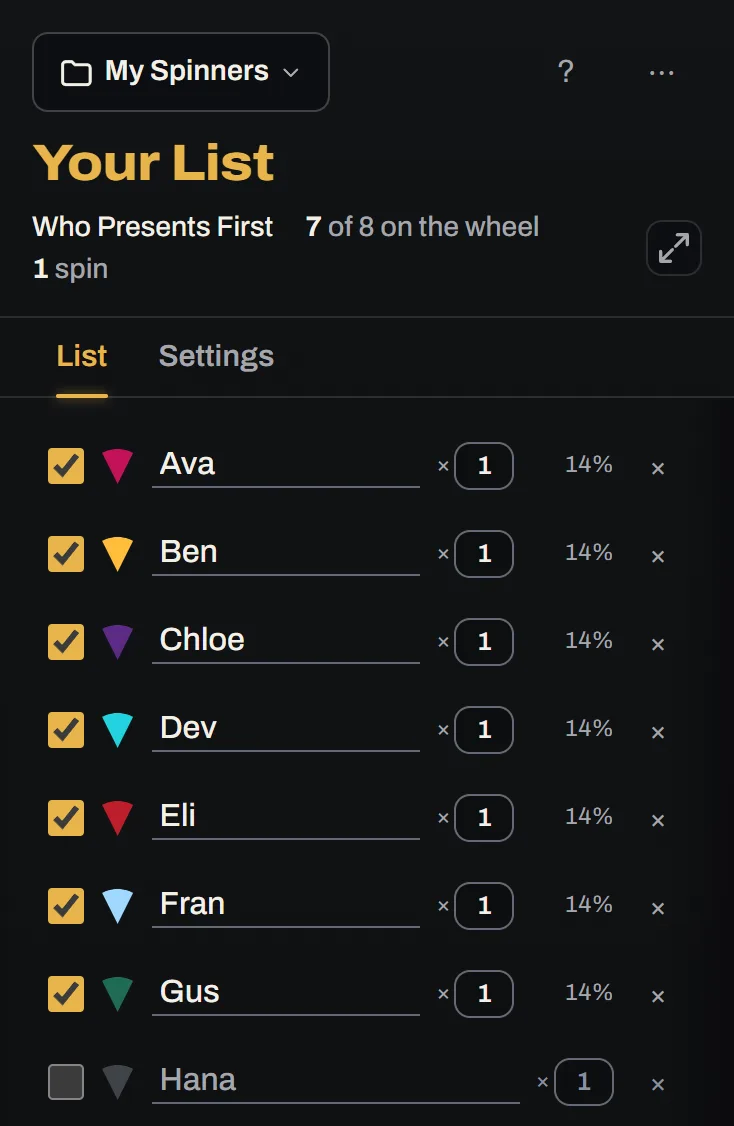
- Open the Settings tab at the top of the list and set After a Win to Retires. Every name keeps the same weight, so each one has the same chance.
- Spin. The name that wins comes out of play and stays on the list unticked. The next spin picks from whoever is left.
- Send the first name to team A and the second to team B, and keep alternating. For a snake, send the third to B, then A, A, B, and so on. With an odd number of players, one team ends up a player larger.
 Open the picture full size, opens in a new tab
To balance by skill, untick everyone outside the group you are dealing from. Spin through the strongest group, then the next. For another round with the same people, choose Put Them All Back On from the More for This List menu. Your History keeps the latest wins, in case you want to check who came out when.
Try It
Paste in the names, choose how many teams, and press Make Teams. For a snake draft, spin the names one at a time with After a Win set to Retires instead.
Read Next
How to Make a Fair Random PickWhy not just pick a name yourself, or count round with a rhyme, and what makes a random pick fair?4 min read Random Pickers in the ClassroomDoes calling on students at random help them take part?3 min read
Sources
This guide draws on these. Last checked October 15, 2026.
- Negative Experiences in Physical Education and Sport, Bradley Cardinal, Zi Yan, and Marita Cardinal, 2013 (opens in a new tab)
- Picking Teams: Motivational Effects of Team Selection Strategies in Physical Education, David Barney and others, 2016 (opens in a new tab)
- Do High School Students Know What Practices Are Appropriate in Physical Education, David Barney and Brad Strand, 2008 (opens in a new tab)
- Draft Order Determination: A Commissioner's Guide, Footballguys (opens in a new tab)