Chore Wheels That Actually Work
Everybody agrees the bathroom needs doing, so how do you hand it out without a fight?
Why a Draw Ends the Argument
When a parent hands out the jobs, the child who gets the bathroom can ask why it is them, and whatever the answer is, it can be argued with. A wheel gives that child nobody to argue with.
There is some research behind the feeling, though not on chores or children. Bolton, Brandts, and Ockenfels ran money games with adults in a lab and concluded that people judge how a result was reached as its own question, apart from whether the result was fair.
The same literature has a catch. Eliaz and Rubinstein surveyed 677 university students and found that two random procedures with identical odds are often not seen as equally fair. In one question, a draw where everybody put in a note beat a draw that picked one person to decide, 52 percent to 5 percent, and 43 percent called them equal. That is a reason to let each person press Spin for their own job.
Weights Change the Odds and Not the Workload
Each job has a weight from 1 to 9. A job at 3 gets a wedge three times the size, so it is three times as likely to come up, and the percentage beside it shows its chance right now.
That matters on a wheel where jobs can repeat. If the dishes happen every day and watering the plants happens twice a week, give the dishes the bigger weight and the wheel follows the household.
With After a Win set to Retires and as many jobs as people, weights stop deciding who works harder. Everybody ends up with exactly one job whatever the weights say. They only change the order the jobs are taken in, and whoever spins first has the best shot at a heavily weighted job. So let a different person spin first each week.
Retire Each Job as It Is Taken
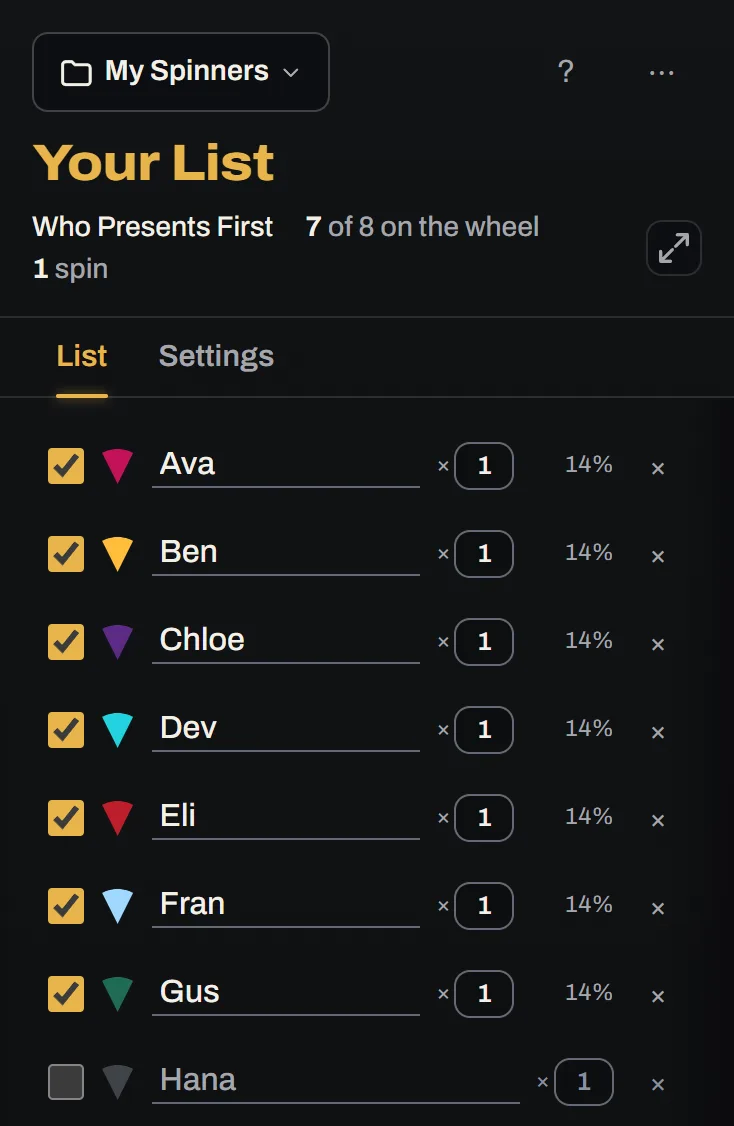
Open the Settings tab at the top of the list and set After a Win to Retires. Each job leaves the wheel the moment it is taken, so nobody draws it twice in a week. The chore wheel starts on Rests, which suits a spin every day instead. A job that just came up shrinks, so it rarely lands twice running.
 Open the picture full size, opens in a new tab
A retired job stays on the list, unticked, so the list doubles as a record of what has gone. Untick a job by hand and it sits out too, which suits one that does not apply this week. When the week turns over, choose Put Them All Back On from the More for This List menu.
Jobs That Fit the Age
A wheel is only fair if everyone on it can do what it lands on. The American Academy of Pediatrics says on HealthyChildren.org that most preschoolers can start with simple household tasks, and it lists jobs for older children in three bands.
- Ages 5 to 7: make their own bed, set and clear the table, put toys away, sort laundry, empty wastebaskets, and fill the pet's food dish.
- Ages 8 to 10: all of those, plus vacuuming, helping make dinner, putting groceries away, and walking the dog.
- Ages 11 to 12: all of those, plus cleaning the kitchen, changing bedsheets, doing and folding laundry, and scrubbing toilets.
Build the wheel from the jobs every child on it can do, or keep one wheel per band. The AAP also says to bring in one new task at a time, because a long list can overwhelm a child, and to praise the effort rather than the result.
What the Research Does and Does Not Say
The study everybody quotes is Marty Rossmann's at the University of Minnesota. The university's own write-up says she looked at 84 young adults, using data Diana Baumrind began collecting in 1967, and that the best predictor of how they were doing in their mid-20s was having done household tasks at ages three or four. Those who only started at 15 or 16 did worse. It is one small group, observed rather than tested, and Rossmann herself wanted it repeated with a larger sample. The full paper is not online, so this rests on that summary.
The same write-up says children should be "involved in determining the tasks they will complete" and should not do them for an allowance. The AAP is softer and says parents may consider allowances and stickers. A lab study by Warneken and Tomasello found that 20-month-olds given a material reward helped less afterward than those given praise or nothing. That was toddlers and helping, not chores. The evidence on pay is thin, so a wheel the whole household agreed to is the safer bet.
Try It
The chore wheel opens with dishes, laundry, vacuuming, and the trash, plus a Free Pass. Edit the list to your household's, set After a Win to Retires, and let each person spin for their own.
Read Next
How to Make a Fair Random PickWhy not just pick a name yourself, or count round with a rhyme, and what makes a random pick fair?4 min read Picking Teams FairlyHow do you split a group into teams fairly, without anybody being the last one picked?4 min read
Sources
This guide draws on these. Last checked October 15, 2026.
- Fair Procedures: Evidence from Games Involving Lotteries, Gary Bolton, Jordi Brandts, and Axel Ockenfels, Economic Journal, 2005 (opens in a new tab)
- On the Fairness of Random Procedures, Kfir Eliaz and Ariel Rubinstein (opens in a new tab)
- Age-Appropriate Chores for Children, HealthyChildren.org, American Academy of Pediatrics (opens in a new tab)
- Involving Children in Household Tasks: Is It Worth the Effort?, Marty Rossmann, University of Minnesota, 2002 (opens in a new tab)
- Extrinsic Rewards Undermine Altruistic Tendencies in 20-Month-Olds, Felix Warneken and Michael Tomasello, Developmental Psychology, 2008 (opens in a new tab)